Signia MaX: Inside the World’s First Hearing Aid with Four-Dimensional AI
Medically reviewed by Krishna Jain, Audiologist · November 2, 2026
Quick Answer
Hearing aids have gotten quieter, smaller, and smarter over the past decade but one problem has stubbornly refused to go away: noisy group conversations. A crowded restaurant. A family dinner with everyone talking at once. A work meeting with cross-talk. These are exactly the moments hearing aid wearers say are hardest to manage, and exactly the moments most devices still struggle with.
Signia’s answer, launched on August 24, 2026, and introduced in India at WSA’s Annual Customer Seminar in Jaipur, Rajasthan, held October 22–24, 2026. is a new platform called Signia MaX (Multi-adaptive Xperience), powered by a technology it’s calling Acoustic Intelligence™. Signia is billing it as the world’s first multi-dimensional AI hearing aid platform and the “multi-dimensional” part is the whole story.
If you’re already exploring options, you can browse the full Signia hearing aids range or see all hearing aid brands and prices we carry.
The Problem with “One-Dimensional” AI
Most modern hearing aids already use some form of AI. But according to Signia, nearly all of them apply it to a single job: noise reduction. That approach can make the world quieter, but often at the cost of connection voices get flattened along with the background noise, and wearers can lose the very speech cues that help them follow a conversation.
Signia’s pitch is that hearing in the real world isn’t a single problem to solve it’s several problems happening at once: What’s speech and what’s noise? Is that my own voice or someone else’s? What kind of environment am I in, and is it changing? And how much noise reduction does this specific moment actually need? Acoustic Intelligence is built to answer all four of these questions simultaneously, not one at a time.
What Acoustic Intelligence Actually Is
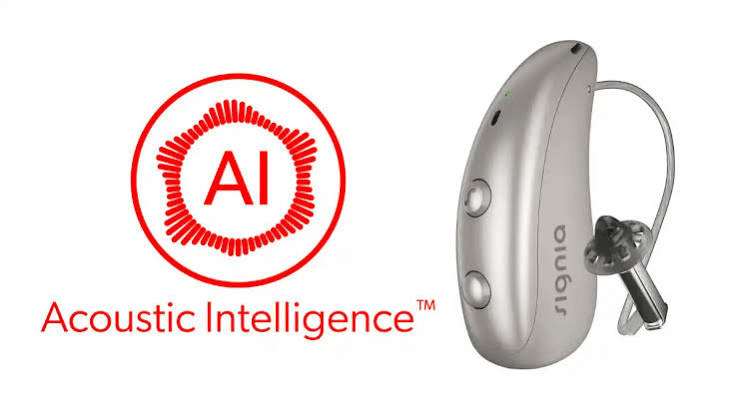
At the core of the platform are four task-specific Deep Neural Networks (DNNs), each trained on a different dimension of sound:
- Speech Detection – identifying speech within a complex soundscape
- Own Voice Detection – recognizing the wearer’s own voice separately from others
- Scene Analysis – understanding what kind of listening environment the wearer is in
- Noise Processing – determining what’s noise, where it’s coming from, and how aggressively to reduce it
The key difference from earlier approaches is that these four networks don’t work in isolation they continuously share information with each other. That means the system isn’t just running noise reduction and calling it done; it’s making sound-processing decisions based on the complete listening situation in real time.
The Four Features This Powers
- RealTime Conversation Enhancement AI — locates and enhances multiple conversation partners in a dynamic group setting, processing 75% more data points per second than Signia’s previous IX platform
- Own Voice Processing AI — recognizes the wearer’s own voice immediately, without requiring in-clinic calibration
- Ambient Scene Adaptation AI — continuously adapts to environmental changes instead of relying on fixed listening programs
- Dynamic Noise Control AI — adjusts noise reduction based on whether the wearer is actively in conversation, not just on ambient volume
Signia also emphasizes that both hearing aids stay synchronized ear-to-ear, so decisions are made as a coordinated binaural system rather than two devices independently guessing at the same soundscape.
The Hardware: A New Chip to Match the AI
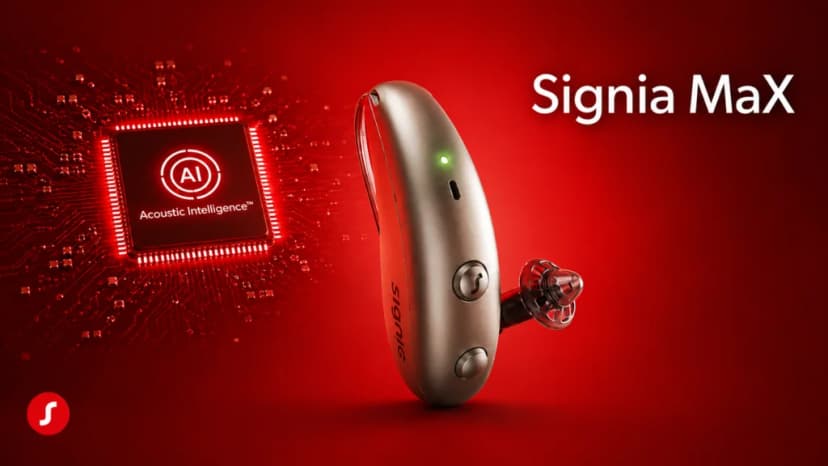
Running four neural networks continuously, all day, on a device that fits in your ear canal, requires serious processing headroom. Signia says the new MaX chip delivers:
- 54x more processing power than the previous generation
- 50% greater energy efficiency
- 2x the memory
That combination is what allows “always-on” AI processing without draining the battery in a few hours a real constraint for hearing aids, unlike phones or earbuds that get recharged multiple times a day.
Meet the First Device: Signia Pure C&G MaX
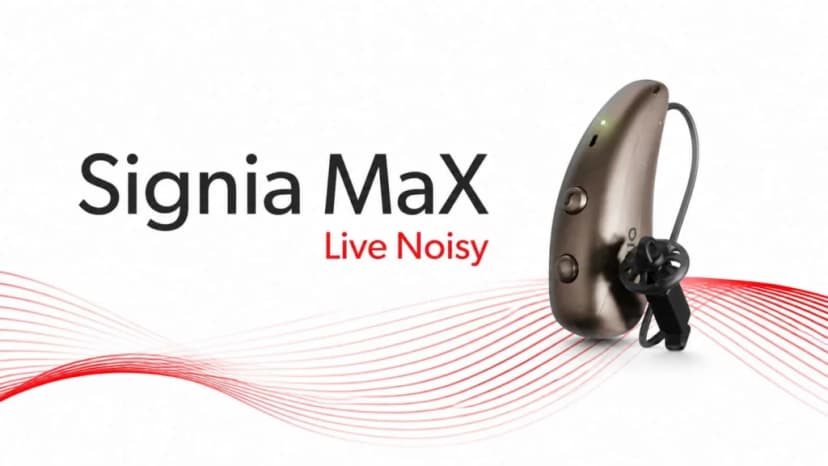
The Pure C&G MaX is the first hearing aid built on the new platform. It’s a receiver-in-canal (RIC) style device — a category known for combining strong performance with a compact, discreet fit — and a few practical details stand out:
- Available in eight color options
- Ships with a pocket-sized portable charger that holds up to four full charges
- Full charge in 4 hours; just 30 minutes of charging delivers 6 hours of runtime
- OneConnect Technology, supporting Bluetooth connectivity, Bluetooth LE Audio, Telecoil, and Auracast meaning hearing care professionals can fit the device without first asking what phone the wearer uses
Like most modern devices in this class, it’s also a rechargeable hearing aid, doing away with disposable batteries altogether.
Auracast is present in the hardware but will be fully activated via a firmware update through the Signia One app, expected by March 2027.
Signia MaX vs Signia Pure Charge&Go IX: Which Is Better?
This is the most important comparison for existing Signia users.
Signia Pure Charge&Go IX has been a strong premium option for understanding conversations in noisy environments, using RealTime Conversation Enhancement technology.
Signia MaX builds on that foundation with a substantially more powerful processor and four AI networks.
Signia Pure Charge&Go MaX Hearing Aid: Review & Prices
Signia Pure C&G MaXNewer Acoustic Intelligence platform
Signia Pure Charge & GO IX Hearing Aids | Advanced Bluetooth Tech – HearMore4Less
Signia hearing aid prices for 2026
Every Signia model with its current price, plus this month's offers. Free PDF.
Signia Pure C&G IXEstablished Integrated Xperience platform
| Feature | Signia Pure C&G MaX | Signia Pure C&G IX |
|---|---|---|
| Platform | Multi-adaptive Xperience | Integrated Xperience |
| AI architecture | Four coordinated DNNs | IX conversation-processing architecture |
| Group conversation tracking | RealTime Conversation Enhancement AI | RealTime Conversation Enhancement |
| Own-voice processing | AI-based, no initial voice training required | Earlier Own Voice Processing approach |
| Processor | New MaX chip | IX-generation processor |
| Processing power | Claimed 54× vs IX | Comparison baseline |
| Connectivity | Bluetooth Classic, LE Audio, telecoil, Auracast-ready | Connectivity varies by IX variant |
| Charging | Rechargeable with portable charger | Rechargeable; charger varies by model |
| Best suited for | Users seeking newest AI processing | Users satisfied with IX performance or looking for value |
Signia MaX vs Phonak, Oticon, ReSound, Starkey and Widex: 2026 Comparison
| Hearing aid | Main technology | Potential strength | Where MaX may be preferable |
|---|---|---|---|
| Signia Pure C&G MaX | Four coordinated DNNs; Acoustic Intelligence | Dynamic group conversations and own-voice processing | Reference model |
| Phonak Audéo Infinio Ultra Sphere | DEEPSONIC AI; Spheric Speech Clarity 2.0 | Speech separation in challenging noise and Roger support | Multi-dimensional scene and own-voice processing |
| Oticon Intent | DNN 2.0 and 4D user-intent sensors | Listening-intent awareness and access to surrounding sounds | Dedicated AI coordination across four sound dimensions |
| ReSound Vivia | Intelligence Augmented and DNN processing | Speech focus, natural sound philosophy and Auracast | Conversation-context processing and own-voice AI |
| Starkey Omega AI | DNN 360 sound processing | AI features and wellness-oriented functionality | Signia’s specialized four-network architecture |
| Widex Allure | W1 platform with natural-sound processing | Natural sound quality and low processing delay | Multi-speaker conversation-focused architecture |
Performance Claims — With a Caveat
Signia’s launch materials cite two headline statistics: that 97% of wearers performed better in noisy group conversations with MaX compared to key competitors, and that MaX ranked No. 1 in signal-to-noise ratio (SNR) performance in group conversation in noise.
Worth flagging for readers: these figures come from Signia-commissioned white papers, not independent, peer-reviewed studies. That doesn’t make them untrue, but it’s the kind of claim worth watching for third-party audiology reviews to confirm as the device reaches more wearers.
Availability
Signia MaX launched on August 24, 2026 in the U.S., Germany, and the Nordic countries and Signia MaX was introduced in India at WSA’s Annual Customer Seminar in Jaipur, Rajasthan, held October 22–24, 2026, with most other markets expected to follow later in the year. our audiologists at HearWave will be able to guide you on fit, pricing, and whether it’s the right upgrade for your specific hearing profile you can book a free trial or visit one of our clinics in Delhi, Noida, or Gurgaon to learn more.
The Bigger Picture
What makes MaX interesting isn’t really the chip or the color options it’s the architectural bet Signia is making: that the future of hearing aids isn’t “better noise cancellation,” but AI systems that understand a listening environment the way a human brain does, weighing speech, identity, context, and noise together instead of in sequence.
Whether that translates to a noticeably better experience at a loud dinner table is something only real-world, long-term wearer feedback and independent audiology testing will confirm. But as a shift in how hearing aid AI is architected, it’s a meaningful one to watch.
If you’d like personalized advice on whether Signia MaX or another current model suits your hearing needs, HearWave’s certified audiologists can walk you through a free trial and help you compare it against other rechargeable and Bluetooth-enabled options on the market.
Frequently Asked Questions (FAQ)
When was Signia MaX launched in the USA?
Signia MaX launched in the United States on August 24, 2026. A U.S. launch celebration was subsequently held in Dallas on September 18, 2026.
When was Signia MaX launched in India?
Signia MaX was introduced to Indian customers and industry partners during WSA’s Annual Customer Seminar in Jaipur, Rajasthan, held October 22–24, 2026. This is the verified introduction event, not necessarily the date nationwide retail sales began.
Is Signia MaX better than Signia IX?
MaX offers newer AI processing, four interconnected neural networks, and significantly greater stated processor capability. Whether this produces a meaningful advantage for an individual wearer depends on their hearing profile and everyday listening needs.
Is Signia MaX better than Phonak Infinio Ultra Sphere?
Both are advanced premium options designed to improve understanding of speech in background noise. Signia emphasizes four-dimensional AI coordination, while Phonak emphasizes real-time speech separation using DEEPSONIC and its Sphere technology. Individual comparison is recommended.
Which Signia hearing aid is best in 2026?
For the newest AI processing, Pure Charge&Go MaX is Signia’s flagship candidate. Styletto IX is worth considering for slim design, and Silk Charge&Go IX is a strong choice for discreet in-canal wear.
Does Signia MaX support Auracast?
It is Auracast-ready, with full functionality scheduled for activation through a firmware update by March 2027.
How long does the battery last? A full charge takes about 4 hours and provides all-day use. A quick 30-minute charge delivers roughly 6 hours of runtime. The included pocket charger can store up to four additional full charges when away from a power outlet.book a free consultation with HearWave